Research
Research vision and scientific directions
My research focuses on developing computational frameworks for multiphysics fluid dynamics, combining rigorous numerical analysis, high-fidelity simulation, and high-performance computing. This work bridges physics, applied mathematics, and computer science to enable predictive modeling of complex fluid dynamical systems. Building on this foundation, our research group develops computational tools to study multiphysics transport phenomena relevant to energy systems, aerospace applications, sustainable transport, hydrogen production, and environmental flows.
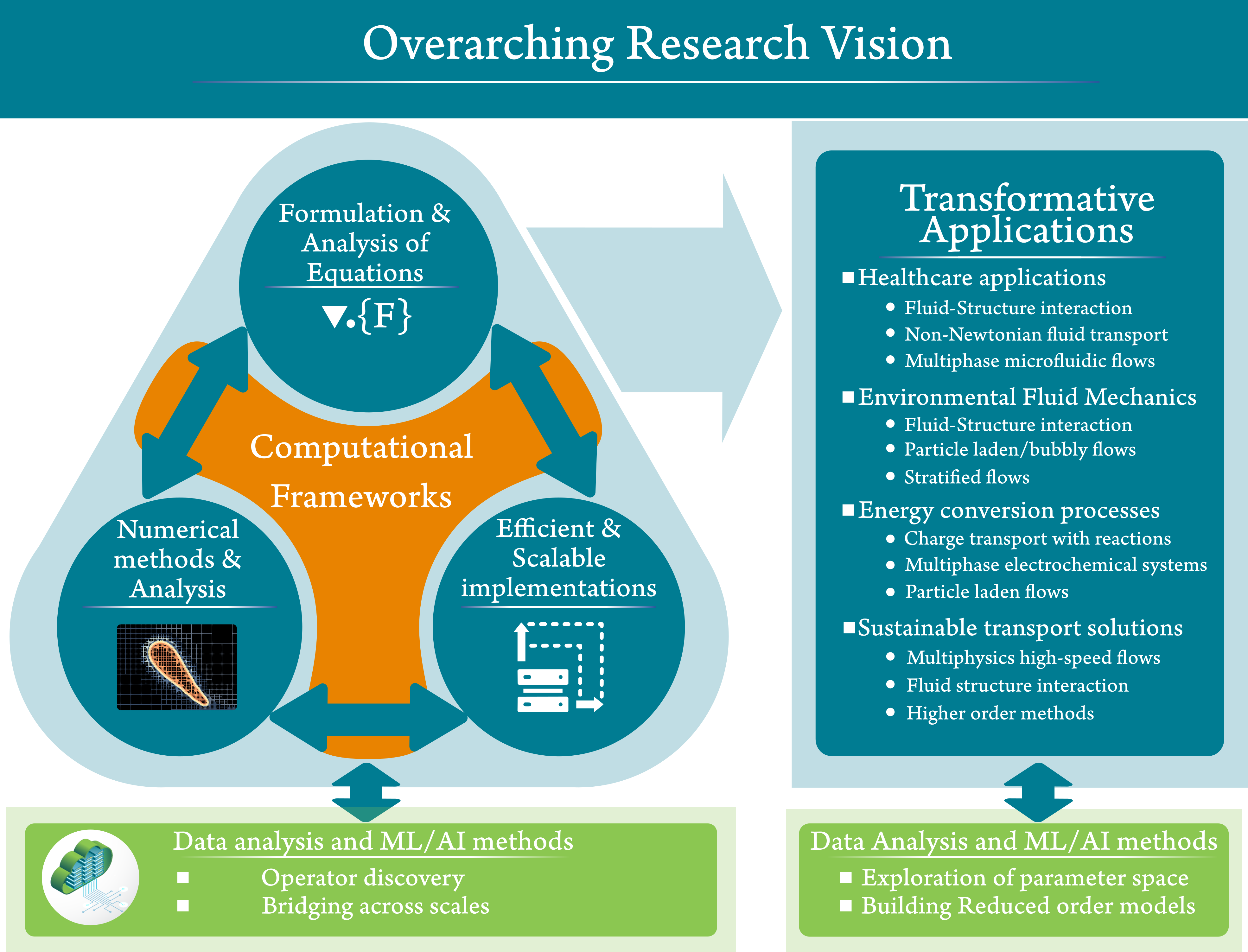
My research group will develop next-generation computational frameworks for predictive simulation and design of multiphysics fluid systems. These efforts integrate mathematical modeling, numerical analysis, and high-performance computing, and increasingly incorporate machine learning to accelerate model development and parameter exploration.
Members in the group will be trained at the intersection of numerical analysis, computational fluid dynamics, and scientific computing, preparing them to address fundamental scientific challenges and develop computational tools for applications in energy, aerospace, and environmental systems.
Prospective Students
I will be establishing my research group at the Technische Universität München beginning May 2026. I am interested in working with highly motivated students who wish to pursue fundamental and applied research in computational mathematics, multiscale multiphysics modeling of fluid mechanics and transport phenomena, and high-performance computing.
Prospective PhD students, postdoctoral researchers, master’s students, and undergraduate researchers with strong backgrounds in fluid mechanics, applied mathematics, numerical analysis, scientific computing, or related fields are encouraged to contact me by email with a brief description of their interests and experience.
Invited Talks and Seminars
2025
- Makrand A. Khanwale. “Unravelling the complexities of breakup dynamics in turbulent multiphase flows through high-fidelity simulations”. Daniel Guggenheim School of Aerospace Engineering, Georgia Institute of Technology (2025). [LINK]
2024
-
Makrand A. Khanwale. “Unravelling the complexities of breakup dynamics in multiphase flows through high-fidelity simulations”. Technical University of Munich (2024).
-
Makrand A. Khanwale. “Unravelling the complexities of breakup in multiphase flow through high-fidelity simulations”. Department of Mechanical Engineering, Iowa State University (2024). [LINK]
-
Makrand A. Khanwale, Kumar Saurabh, Masado Ishii, Hari Sundar, and Baskar Ganapathysubramanian. “Accurately capturing breakup dynamics in multiphase flows using scalable adaptive algorithms”. Minisymposium on Performance and Accuracy Tradeoffs of Adaptive Mesh Refinement for Interfaces, SIAM Conference on Parallel Processing for Scientific Computing (2024). [LINK]
2021
- Makrand A. Khanwale. “Energy-stable numerical schemes for simulating two-phase flows by solving Cahn-Hilliard Navier–Stokes equations on adaptive octree meshes”. CTR Tea Seminar, Department of Mechanical Engineering, Stanford University (2021).
2019
- Makrand A. Khanwale. “Provably energy stability for second-order time integration schemes for Cahn-Hilliard Navier–Stokes equations”. Junior Analysis Seminar, Department of Mathematics, Iowa State University (2019).